Introduction
If you are planning a trip to Dehradun and have only one afternoon to spare, spend it at Robber’s Cave.
Locally known as Guchhupani, Robber’s Cave Dehradun is a 600-metre-long natural river cave carved into the limestone rock of the Doon Valley. What makes Robber’s Cave Dehradun truly unique is that you can literally walk inside a mountain with a river rushing between your feet — and pay less than ₹50 for the experience. That combination of raw geological drama, cool water, and surprising accessibility is why it consistently ranks among the most visited attractions in all of Uttarakhand.
The cave gets its English name from the colonial era, when local legend held that dacoits used its narrow gorges to hide from British police. The Hindi name Guchhupani translates loosely to “hidden water” — a nod to the cave’s most extraordinary feature: a stream that disappears completely underground and reappears a few meters away, as if the rock has swallowed it whole. It is a geological phenomenon that scientists call a losing stream, and it is genuinely unlike anything most travelers have seen before.
In 2026, Robber’s Cave Dehradun remains one of the most affordable, accessible, and genuinely exciting natural attractions in North India. This complete travel guide covers everything — the Robber’s Cave Dehradun timing, entry fee, exact location, how to reach it from anywhere in the city, the best time to visit, practical travel tips, and the best nearby places to combine in a single day.
Whether this is your first visit or you are returning after years, this guide will make sure you are prepared and do not miss a thing.
Robber’s Cave Dehradun: Timing, Entry Fee, and Location
Before anything else, here are the practical details that most people search for first — the Robber’s Cave Dehradun timing, entry fee, and exact location. Get these right and the rest of the visit falls into place easily.
Robber’s Cave Timings 2026
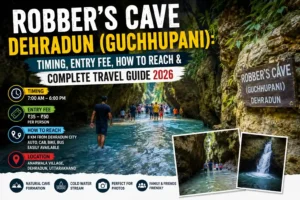
Robber’s Cave Dehradun is open every day of the week, including public holidays. The official timings are 8:00 AM to 5:00 PM. The site does not have a fixed closing time for visitors already inside, but gates stop allowing new entry at 5:00 PM sharp. Arriving by 4:00 PM at the latest gives you comfortable time to explore without feeling rushed.
The cave is typically closed or partially restricted during heavy monsoon rains in July and August, when water levels inside the gorge rise significantly and make entry unsafe. Always check locally before visiting during the monsoon months.
Best visiting window within the day: 8:00 AM to 11:00 AM. Crowds are lighter, the morning light filters beautifully through the gorge walls, and the water is at its clearest.
Robber’s Cave Entry Fee 2026
Entry to Robber’s Cave Dehradun costs ₹25 per person for Indian nationals. Some sources list ₹30 to ₹35 due to small seasonal or local authority adjustments — carry ₹50 per person to be safe and avoid any inconvenience at the gate.
Additional charges to be aware of: Parking for two-wheelers: ₹20 Parking for four-wheelers: ₹30 Locker rental (if you do not want to carry valuables inside): ₹30 Changing room rental (to change after getting wet): ₹20
Total realistic spend at the gate including parking and locker: ₹80 to ₹120 per person. Still remarkably cheap for one of Dehradun’s best experiences.
Foreign nationals are sometimes charged a different rate — confirm at the gate on arrival.
Robber’s Cave Location and Distance from Dehradun
Robber’s Cave is located in Anarwala village, approximately 8 to 9 kilometres from Dehradun city centre. The closest major landmarks for navigation are ISBT Dehradun (the main bus terminal) and Sahastradhara, which is roughly 2 to 3 kilometres further along the same road.
Google Maps address: Guchhupani, Anarwala, Dehradun, Uttarakhand 248001 Coordinates: 30.3736° N, 78.0987° E
From Dehradun Railway Station: approximately 10 km, 20 to 30 minutes by road depending on traffic. From ISBT Dehradun: approximately 8 km, 15 to 25 minutes. From Clock Tower (city centre): approximately 8 km, 20 minutes. From Jolly Grant Airport: approximately 35 km, 45 to 60 minutes.
The road to Robber’s Cave is well-maintained and signposted from the main city. You will not need directions if you are using Google Maps — just search “Guchhupani Dehradun” and it will take you directly there.
How to Reach Robber’s Cave Dehradun
There are four practical ways to reach Robber’s Cave from Dehradun city. The right option depends on your budget, group size, and where you are staying.
By Shared Vikram Auto (Cheapest Option)
Shared Vikram autos are Dehradun’s most affordable local transport and the best budget option for reaching Robber’s Cave. From Clock Tower or Paltan Bazaar, take a Vikram headed toward Anarwala or ask for the Guchhupani route. The fare is ₹15 to ₹25 per person. The Vikram will drop you near the main road, from where it is a short 5 to 10 minute walk to the cave entrance.
Note: Vikrams run on fixed routes and do not go door to door. You may need to take one shared auto to an intermediate point and a second one onward. Ask locally — Dehradun residents are generally helpful with directions.
By App-Based Auto (Comfortable, Budget-Friendly)
Rapido and Ola autos are widely available in Dehradun and offer the cleanest single-vehicle option for solo travelers or couples. The fare from Clock Tower or ISBT to Robber’s Cave runs approximately ₹60 to ₹90, depending on surge pricing and exact pickup point. The ride takes 20 to 30 minutes.
This is the most recommended option for first-time visitors who want a direct, hassle-free journey without navigating shared transport routes.
By Private Taxi or Cab (Best for Groups)
If you are traveling in a group of three or more, hiring a private taxi for a half-day or full-day sightseeing tour is the most cost-efficient option. A half-day Dehradun sightseeing taxi that includes Robber’s Cave and Sahastradhara typically costs ₹800 to ₹1,200 for the vehicle. Split between four passengers, this comes to ₹200 to ₹300 per person — comparable to or cheaper than individual auto rides, with the added convenience of door-to-door pickup and drop-off.
For a full day covering Robber’s Cave, Sahastradhara, FRI, and other attractions, see the complete Dehradun travel guide on Chalo Pahaad for suggested itineraries.
By Personal Vehicle or Rented Bike
Dehradun is a compact, easy city to navigate by two-wheeler or car. If you have your own vehicle or have rented a bike, the drive to Robber’s Cave takes 20 to 25 minutes from the city centre via the Haridwar Road and then Sahastradhara Road. Parking is available at the cave entrance at ₹20 for two-wheelers and ₹30 for four-wheelers.
The route passes through scenic residential and forested stretches and is entirely paved. Avoid the route between 8:30 AM and 10:00 AM on weekdays as school traffic can slow things near the city centre.
Best Time to Visit Robber’s Cave Dehradun
Getting the timing right makes a significant difference to the Robber’s Cave Dehradun experience. The cave itself is natural, which means weather, season, and time of day all affect what you find when you arrive.
Best Season: September to June
The most comfortable and visually rewarding time to visit Robber’s Cave Dehradun is the post-monsoon and pre-summer window from September through June. Within this window, two sub-periods stand out:
October to November is arguably the single best time. The monsoon has ended, the cave water is crystal clear, the surrounding vegetation is lush green, and the gorge walls have been washed clean. Visibility inside the cave is excellent and temperatures are ideal for wading through the stream — not too cold, not too warm.
March to June is the peak tourist season and for good reason. Dehradun gets pleasantly warm during the day, the water inside the cave feels refreshing rather than biting, and this is the best time for families with children. The cave is most photogenic between March and May when the light angle in the afternoons creates dramatic shadows across the gorge walls.
Monsoon Season (July to August): Approach With Caution
The monsoon transforms Robber’s Cave significantly. Water levels inside the gorge can rise to waist or chest level, and flash flooding is a documented risk. The site is sometimes partially or fully closed during heavy rainfall weeks. Entry may still be permitted on clear monsoon days, but the experience is unpredictable and conditions can change rapidly.
If you do visit during monsoon, go early in the morning, watch weather forecasts the evening before, and leave immediately if water levels begin rising. Do not take children inside the cave during monsoon months.
Winter (December to February): Cold but Quiet
December and January bring the fewest crowds and the most peaceful atmosphere at Robber’s Cave. The water is bitterly cold — wading into the stream is not for everyone in winter — but the cave is exceptionally quiet and the gorge views are striking in the dry, clear air. If you are not set on getting wet, this is actually an excellent time for photography and a peaceful visit.
Best Time of Day: Early Morning
Regardless of season, the single most reliable advice for Robber’s Cave Dehradun is to arrive early. The cave opens at 8:00 AM and the first hour and a half — before the tourist buses arrive from ISBT — is when the experience is best. The light is softer, the water is calmer, the stall vendors have not yet set up, and you can genuinely hear the stream echoing through the narrow gorge without talking over a crowd.
If you are staying in Dehradun and planning your sightseeing days, the budget trip to Dehradun guide has a day-by-day itinerary that builds in an early Robber’s Cave visit on Day 2.
What to Expect: The Robber’s Cave Dehradun Experience
The Cave Layout
Robber’s Cave is divided into two main sections connected by a narrow gorge. The entrance is at a lower elevation and the cave extends upward into the hillside. The entire walkable stretch covers roughly 600 metres, though most visitors explore the first 200 to 300 metres where the primary geological features — the disappearing stream, the waterfall, and the narrowest gorge passages — are concentrated.
The floor of the cave is the streambed itself. You will wade through water ranging from ankle-deep at the entrance to knee-deep in the middle sections. Sturdy sandals or old shoes with grip are strongly recommended. Flip-flops and formal shoes are both poor choices — the rocks underfoot are slippery and uneven.
The Disappearing Stream: Guchhupani’s Star Feature
The defining feature of Guchhupani Dehradun is the stream that vanishes. At a specific point in the cave, the water flowing between your feet disappears into the limestone rock and reappears several metres further along — as if the mountain has absorbed it. This is a natural phenomenon caused by the porous and fractured nature of the conglomerate limestone geology of the Doon Valley’s Dehra Plateau.
Standing at the point of disappearance and watching the water vanish at your feet is genuinely disorienting and memorable. It is the kind of thing that photographs do not fully capture — you need to be there to appreciate the strangeness of it.
The Waterfall
Inside the cave, a waterfall drops approximately 10 metres into a natural pool. This is where most visitors stop, take photographs, and turn back. The pool at the base of the waterfall is 3 to 4 feet deep at its centre — enough to stand in but not to swim freely. The water is cold even in summer and provides an extraordinary contrast to Dehradun’s heat.
Photography and the Robber’s Cave Dehradun Photos Experience
The gorge is a natural studio. The narrow rock walls, the filtered light, the rushing water, and the dark cave passages create conditions that make even phone cameras produce striking images. The most photogenic moments are at the waterfall base (morning light is ideal) and at the entrance to the cave where the contrast between the dark gorge and bright daylight is at its strongest.
Keep your phone and camera protected. The water splashes, the air is humid, and drops of water fall from the cave ceiling constantly. A waterproof phone case or a ziplock bag is the most practical protection.
The Surrounding Area
Beyond the cave itself, the Anarwala area around Guchhupani is covered in dense sal forest with walking paths that extend in several directions. After exiting the cave, the surrounding greenery and stream banks make for pleasant, unhurried time. Several small food stalls sell chai, Maggi, corn, and snacks at reasonable prices — slightly higher than city rates but fair for the location.
For serious walkers, this area connects to the network of hidden trails near Dehradun that run through the Anarwala forest. Most of these are free, uncrowded, and reward you with forest and hill views that feel entirely disconnected from the city below.
Travel Tips for Robber’s Cave Dehradun 2026
These are the practical things that most travel articles skip over but that make a real difference to your visit.
What to Wear and Carry
Wear clothes you are comfortable getting wet in. The cave involves wading and the waterfall creates significant splash — you will get wet whether you intend to or not. Light synthetic fabrics dry faster than cotton. Avoid jeans.
Footwear is the single most important decision for the Robber’s Cave Dehradun experience. Wear old sports shoes or sturdy rubber sandals with ankle straps. The rocks inside the cave are covered in a thin layer of algae and are extremely slippery in places. Several minor injuries at Robber’s Cave every year result from flip-flop-wearing visitors losing their footing. The locker at the entrance (₹30) can hold your good shoes and bag if needed.
Carry a small dry bag or a ziplock bag for your phone, wallet, and any documents. The humidity inside the cave is extreme and water drops fall from the ceiling throughout the walk.
What to Leave Behind
Do not bring large backpacks inside the cave. The gorge narrows significantly in places and a large bag will slow you down and catch on the rock walls. Use the locker facility at the entrance.
Do not bring plastic bags or packaging inside — the cave has a littering problem and the site management has become stricter about enforcement in 2026. Carry reusable containers.
Do not bring young children who cannot swim or who are afraid of enclosed spaces or cold water. The cave can feel claustrophobic and the water can be alarming for small children who are not prepared for it.
Practical Timing Tips
Arrive as early as possible. 8:00 AM to 9:30 AM is the golden window on weekdays. On weekends and public holidays, the cave fills quickly by 10:30 AM and the experience becomes significantly less enjoyable with crowds.
Do not visit during or immediately after heavy rainfall. The water level inside rises rapidly and without much warning. Always check the weather in Dehradun the evening before your visit.
Allow 2 to 3 hours for a complete visit including changing, lockers, the cave walk, the waterfall, and the surrounding area. Budget travelers combining this with Sahastradhara (2 to 3 km away) should plan for a 5 to 6 hour half-day.
Budget Tips
The entry fee is fixed. Do not pay anyone who approaches you outside the gate offering “guided entry” or “special packages” — these are unofficial and unnecessary. Buy your ticket directly at the official counter at the main entrance.
Food and chai outside the cave entrance is reasonably priced and worth trying after your visit. The Maggi and chai combination at the small stalls near the car park is a Robber’s Cave tradition at this point — genuinely good and cheap.
Nearby Places to Visit After Robber’s Cave Dehradun
One of the biggest mistakes visitors make is treating Robber’s Cave as an isolated stop. The area around Guchhupani connects directly to several excellent nearby attractions that can be combined into a half-day or full-day itinerary without significant extra transport cost.
Sahastradhara — 2 to 3 km from Robber’s Cave
The closest and most natural companion to a Robber’s Cave visit. Sahastradhara — meaning “thousandfold springs” — is a complex of natural sulphur waterfalls and mineral pools set into the hillside. Entry is free. The sulphur pools are believed to have healing properties and locals have been visiting for generations. A ropeway ride to the hilltop above Sahastradhara costs ₹80 to ₹100 and offers a panoramic view of the Doon Valley.
After the physical exertion of wading through Robber’s Cave, the calm mineral pools at Sahastradhara are the ideal way to spend an afternoon. The two sites together cover the best of the natural Dehradun experience.
Tapkeshwar Mahadev Temple — approximately 5 km
One of Dehradun’s most atmospheric spiritual sites. Tapkeshwar is an ancient cave temple dedicated to Lord Shiva where water drips continuously from the cave ceiling onto the Shivling — the phenomenon that gives the temple its name. Entry is free and the experience is unlike any conventional temple visit. The cave setting, the sound of dripping water, and the devotional atmosphere create something quietly extraordinary.
For travelers interested in Dehradun’s spiritual geography, the monasteries in Dehradun guide covers the city’s broader religious and spiritual landscape including Tibetan Buddhist sites in Clement Town.
Malsi Deer Park — approximately 8 km
A small wildlife sanctuary on the Mussoorie road where spotted deer, sambhars, and peacocks can be seen at close range. Entry costs ₹30 per person. Best visited in the morning when animals are active. Particularly enjoyable for families and anyone who wants a gentle, peaceful experience after the more physically demanding cave visit.
Forest Research Institute (FRI) — approximately 12 km
One of the most architecturally impressive buildings in India — a colonial-era campus spanning 450 hectares with six museums and forest-lined walkways. Entry costs ₹50. The FRI is particularly rewarding in the afternoon when the light hits the building’s facade at an angle that makes the stonework glow. See the full top places to visit in Dehradun guide for detailed visiting information.
Mindrolling Monastery — approximately 14 km
One of Asia’s largest Tibetan Buddhist monasteries, featuring a 185-foot stupa and remarkable Thangka-inspired murals. Entry is free. The monastery is calming, beautiful, and a meaningful contrast to the natural adventure of Robber’s Cave. If you are planning a full Dehradun day, Robber’s Cave in the morning and Mindrolling in the late afternoon covers two completely different but equally memorable experiences.
Mussoorie — approximately 35 km
If your itinerary extends beyond a single day, Mussoorie is an obvious next step. The Queen of the Hills sits 35 km from Dehradun and is accessible by shared taxi (₹80 to ₹120 per person) in under an hour. The Dehradun to Mussoorie travel guide 2026 covers the complete route, budget, and what to do once you get there.
Robber’s Cave Dehradun Review: What Visitors Say in 2026
The consistent thread across recent Robber’s Cave Dehradun reviews in 2026 is the same one that has defined the place for decades — the sheer unexpectedness of it.
Most visitors arrive expecting a modest cave and leave having experienced something genuinely dramatic. The 10-metre waterfall inside the gorge surprises nearly everyone who has not seen photos. The disappearing stream confuses and delights in equal measure. The narrowness of the gorge passages creates a mild sense of adventure that photographs do not fully communicate. And the cold water — even in the middle of a hot May afternoon — shocks and refreshes in a way that visitors consistently describe as the highlight of their Dehradun trip.
The main criticisms in recent reviews are practical rather than substantive: littering by some visitors, the occasional aggressive stall vendor near the entrance, and crowding on weekends and public holidays. All three issues are manageable with the tips covered in this guide — arrive early, use the locker facility, buy your ticket at the official counter, and visit on a weekday if possible.
For Robber’s Cave Dehradun photos that capture the actual experience — not the postcard version — search for recent Google Maps uploads from 2025 and 2026. The user-generated images, especially those showing the waterfall and the disappearing stream, are significantly more accurate than stock photography.
Frequently Asked Questions — Robber’s Cave Dehradun (Guchhupani)
What is special about Robber’s Cave?
Robber’s Cave, or Guchhupani, is special for three reasons. First, it is one of very few natural river caves in India where visitors can walk inside the cave itself along the streambed. Second, it contains a rare geological phenomenon — a losing stream — where the water disappears underground and reappears meters away. Third, it has a 10-metre waterfall inside the gorge that catches nearly every visitor off guard. The combination of a natural cave, a river flowing through it, a disappearing stream, and a hidden waterfall in a single 600-metre walk is genuinely unusual and makes for a memorable experience regardless of age or travel experience.
Is Robber’s Cave safe to visit?
Yes, Robber’s Cave is safe to visit under normal conditions. The site has been a popular tourist destination for decades and is managed by the local administration. The cave walk involves wading through a rocky stream and the ground is uneven and slippery — appropriate footwear (see the travel tips section above) is the single most important safety consideration. The site should be avoided during and immediately after heavy rainfall, when water levels can rise rapidly. Visitors with serious mobility limitations or very young children should exercise judgment at the entrance before proceeding into the narrower gorge sections.
Can we swim in Robber’s Cave?
Full swimming is not possible inside the cave due to the shallow depth and the rocky streambed. The water ranges from ankle to knee depth along most of the cave walk, with a deeper pool (3 to 4 feet) at the base of the waterfall. Many visitors stand in the pool and splash water, which is entirely safe. The water is cold throughout the year — refreshing in summer and biting in winter. There is no official swimming zone and the site management does not permit swimming in the cave passages themselves.
What is the entry fee for Robber’s Cave Dehradun in 2026?
The entry fee for Robber’s Cave Dehradun is approximately ₹25 to ₹35 per person for Indian nationals. Additional charges apply for parking (₹20 to ₹30), locker rental (₹30), and changing room use (₹20). Total spend at the gate for a single visitor with parking and a locker is approximately ₹80 to ₹120.
What is the best time to visit Robber’s Cave Dehradun?
October to November (post-monsoon) and March to May (spring-summer) are the two best periods. Within any given day, arriving at opening time (8:00 AM) gives you the lightest crowds and best experience. Avoid July and August due to monsoon flooding risk.
What is Robber’s Cave also known as?
Robber’s Cave is also known as Guchhupani — a Hindi name meaning “hidden water.” This is the name most commonly used by Dehradun locals. When searching on Google Maps, both “Robber’s Cave Dehradun” and “Guchhupani Dehradun” will return the correct location.
How long does it take to visit Robber’s Cave?
Allow 1.5 to 2 hours for the cave visit itself, including the walk in, time at the waterfall, and the walk out. Add 30 minutes for changing, locker use, and tea/snacks at the stalls near the entrance. Total time at the site: 2 to 2.5 hours. Most visitors combine it with a Sahastradhara visit on the same day, making for a 4 to 5 hour half-day outing.
How far is Robber’s Cave from Dehradun city centre?
Robber’s Cave is approximately 8 to 9 kilometres from Dehradun city centre (Clock Tower area). The drive takes 20 to 30 minutes depending on traffic. From Dehradun Railway Station the distance is around 10 km.
What should I wear to Robber’s Cave?
Wear light, quick-drying clothes and bring a spare set to change into afterward. Footwear is critical — wear rubber sandals with ankle straps or old sports shoes. Avoid flip-flops and formal shoes. The ground inside the cave is wet, rocky, and slippery. Carry your phone in a waterproof case or ziplock bag.
Is Robber’s Cave open in monsoon?
Robber’s Cave may be open on clear monsoon days but is frequently restricted or closed during and after heavy rainfall in July and August due to rising water levels. Always verify locally before making the trip during monsoon months.
Final Thoughts: Why Robber’s Cave Deserves Its Place on Every Dehradun Itinerary
Dehradun has no shortage of things to do. The Forest Research Institute, the monasteries of Clement Town, the mountain cafes on Rajpur Road, the Tapkeshwar Temple — every one of them earns its place in a well-planned Dehradun itinerary.
But Robber’s Cave, or Guchhupani, holds a different kind of appeal. It is not a viewpoint or a monument or a spiritual site. It is a living geological experience — a place where you can stand in the middle of a mountain with a river running over your feet, watch the water disappear into solid rock, and look up at a waterfall that most people had no idea existed until they turned the last corner of the gorge.
At ₹25 to ₹35 entry, it is also one of the most remarkable things you can do in India for the cost of a chai and a samosa.
Go early. Wear the right shoes. Bring a dry bag for your phone. And expect to be surprised.
For the full picture of what Dehradun has to offer beyond Robber’s Cave, the Dehradun Travel Guide on Chalo Pahaad covers every major attraction, neighborhood, and experience in the city with the same level of detail as this guide